Seedance 2.5 Review: ByteDance's 30-Second AI Video Model, Tested Against Kling, Veo, and Sora
ByteDance shipped Seedance 2.5 on July 31, 2026: native 30-second single-shot clips, 4K output, and up to 50 reference inputs. Here is what is actually confirmed, what is still vendor talk, the copyright history you need to know, and how it stacks up against Kling 3.0, Veo 3.1, and Sora 2.
TL;DR
ByteDance announced Seedance 2.5 on June 23, 2026 at its Volcano Engine FORCE conference, then officially released it on July 31, 2026. It rolled out first to Jimeng AI and Doubao Professional inside China, with the Volcano Ark developer API and wider international access still pending as of this writing.
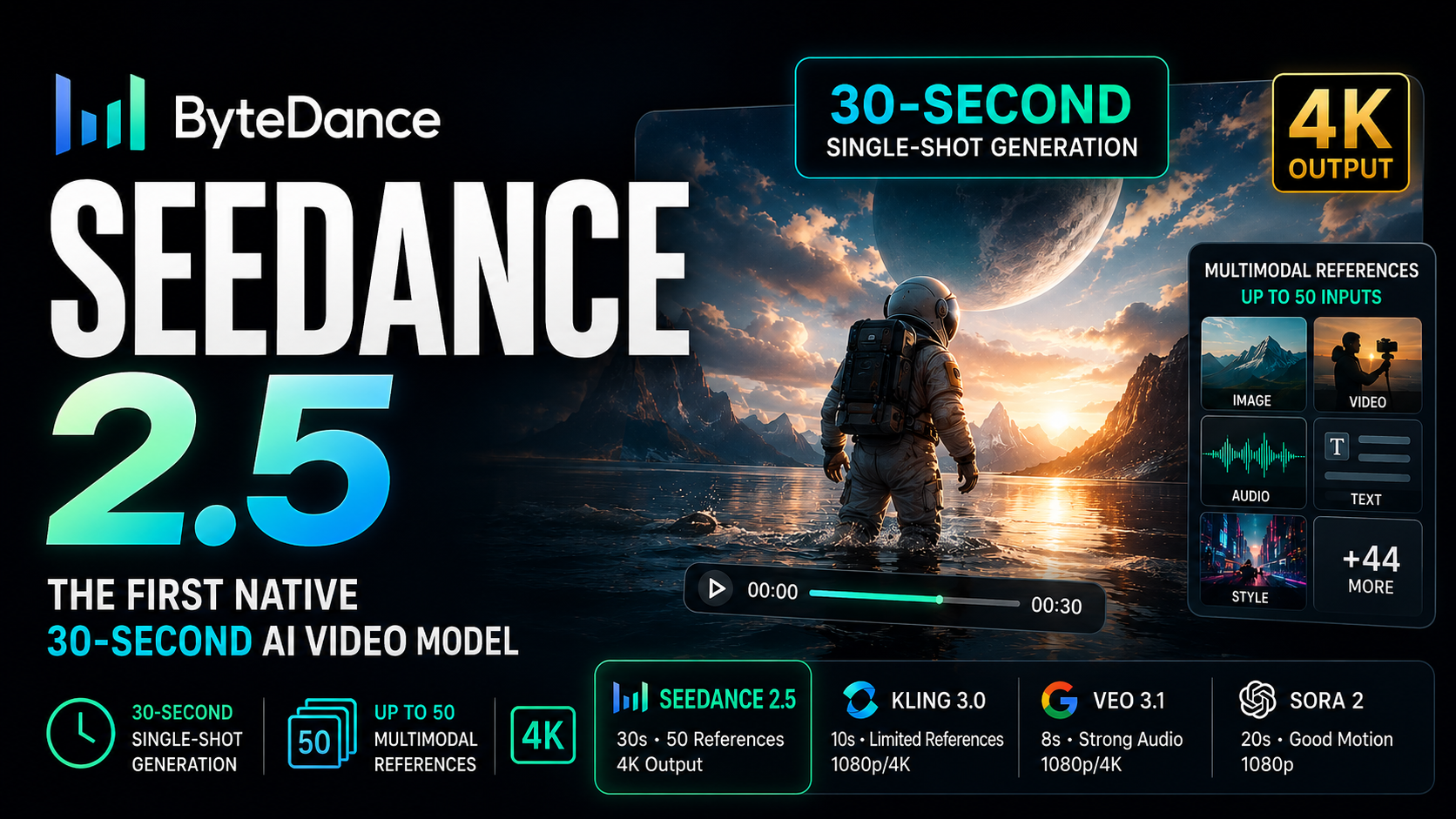
Native 30-second single-shot video generation in one continuous pass, roughly double what Seedance 2.0 offered and well beyond the 5 to 15 second ceiling most competing models ship today. A separate Ultra-Long beta mode has been spotted generating up to 180 seconds.
Seedance 2.5 accepts up to 50 multimodal reference inputs, images, video, audio, and text, in a single generation to lock in identity, setting, camera language, and style. No competing model currently offers anything close to that number.
As of early August 2026, ByteDance has not published a standardized benchmark table, and no third-party evaluator has run Seedance 2.5 against Kling, Veo, or Sora on identical prompts. Every comparative claim circulating online right now is either a launch demo or vendor-stated spec, not measured data.
Seedance 2.0 drew a formal cease-and-desist from the Motion Picture Association in February 2026, its first such letter to a major AI company, after the tool went viral for generating clips of real actors and copyrighted characters. Seedance 2.5 inherits the content filters ByteDance added in response.
ByteDance has not published a rate card. Early Volcano Engine console listings suggest a base rate in the $0.09 to $0.21 per second range, with premium video-conditioned generations running significantly higher. Seedance 2.0's roughly $0.06 per second through third-party providers remains the best available anchor.
Seedance 2.5: ByteDance's 30-Second AI Video Model, Reviewed Honestly
ByteDance did something unusual with this release. It announced Seedance 2.5 on a keynote stage on June 23, 2026, at its Volcano Engine FORCE conference in Beijing, then took another five weeks to actually ship it. The official release landed July 31, 2026, rolling out first to Jimeng AI and Doubao Professional inside China, with the developer API still not live as of this writing.
That gap matters for how you should read this article, and honestly, for how you should read every other Seedance 2.5 review you find right now. A lot of what is circulating online is launch-demo footage and vendor specification sheets dressed up as tested fact. I want to be direct about where the line sits: what ByteDance has confirmed, what independent testers have actually verified, and what remains an unproven claim.
Here is the complete picture.
What Actually Shipped, and When
The timeline is worth laying out precisely, because the announcement-to-release gap is itself informative about how ByteDance is managing this launch.
June 23, 2026: Seedance 2.5 previewed on stage at Volcano Engine FORCE in Beijing, alongside a 4K upgrade to the existing Seedance 2.0, a new image model called Seedream 5.0, and a refreshed Seed 2.1 language model family. Volcano Engine president Tan Dai framed 2.5 as entering global enterprise beta, with public launch targeted for early July.
Early to mid July 2026: The public launch slipped past its original early-July target. A beta feature called Ultra-Long Video, capable of generating clips up to 180 seconds, was spotted running on ByteDance's Jimeng app on July 9.
July 31, 2026: ByteDance officially released Seedance 2.5, rolling it out to Jimeng AI and Doubao Professional. The Volcano Ark developer API, ByteDance's international-facing API platform, was described as coming "in the near future" with no specific date attached. No standardized benchmark table and no official pricing accompanied the release.
The version numbering itself is a deliberate signal. ByteDance skipped 2.1 through 2.4 entirely, jumping straight from 2.0 to 2.5 to communicate that this is a generational leap rather than a routine point release. Whether the underlying capability jump matches that framing is the question the rest of this review works through.
The Headline Feature: 30 Seconds, One Continuous Pass
The number ByteDance wants you to remember from this launch is 30. Seedance 2.5 generates a native 30-second video clip in a single pass, without stitching together shorter segments, which ByteDance is positioning as the longest single-shot duration of any video model currently shipping. For comparison, most competing models, including Runway Gen-4.5, Pika 2.5, and Hailuo, cap out somewhere between 5 and 15 seconds per generation, requiring you to chain multiple clips together for anything longer.
The underlying architecture claim is a sparse Diffusion Transformer combined with unified audio-video latent processing, meaning the model generates picture and synchronized sound from the same underlying representation rather than bolting audio on as a separate pass. That is a genuinely interesting technical direction, and it is consistent with the trajectory ByteDance has followed since the original Seedance launched in June 2025. It has not, however, been independently confirmed through any published technical paper or third-party architecture analysis. Treat it as ByteDance's stated design, not a peer-reviewed fact.
Beyond the standard 30-second mode, a separate Ultra-Long Video beta has been observed generating clips up to 180 seconds on the Jimeng app. This feature has not been formally documented as a general-availability capability, and its stability, cost, and broader rollout timeline remain unclear.
Up to 50 Reference Inputs: The Feature Nobody Else Offers
If clip length is the headline, reference handling is the feature I think actually matters more for production work.
Seedance 2.5 accepts up to 50 multimodal reference inputs, spanning images, video clips, audio samples, and text, in a single generation. Those references can independently describe identity, setting, composition, motion, camera language, voice, rhythm, or creative style. In practice, this means you can feed the model a product photo, a brand color palette, a reference camera move from an existing video, a voice sample, and a written style brief, all at once, and get a single coherent output that respects every constraint simultaneously.
No competing video model currently ships anything close to that reference capacity. This is the capability that ByteDance's own release material leans on hardest, framing Seedance 2.5 around "30-second storytelling, precise reference control, and editing" rather than around simple text-to-video generation. For brand and product teams that need visual consistency across a campaign, this is a genuinely different value proposition than raw prompt-to-video quality.
Seedance 2.5 also introduces region-level, or local, editing: you can direct a change to a specific part of a frame or a specific time range, revising a character, an action, a sound, a camera viewpoint, or a plot beat, without regenerating the entire clip from scratch. Combined with the 50-reference capacity, ByteDance is clearly building toward an iterative creative workflow rather than a one-shot prompt lottery.
What Is Still Missing: Benchmarks and Pricing
Here is where I want to be unambiguous, because most coverage of this launch has not been.
As of early August 2026, ByteDance has not published a standardized numeric benchmark for Seedance 2.5. There is no official comparative win rate against another model, no named public leaderboard score, no disclosed speed study, and no published evaluator protocol that would support a ranked claim against Kling, Veo, or anything else. Every "Seedance 2.5 crushes the competition" post circulating right now is working from launch demos and early community testing, not a controlled, repeatable evaluation. That is not a knock on the model. It is simply the honest state of the evidence today, and any review claiming otherwise is overstating what is actually known.
Pricing is in the same position. ByteDance has not published a rate card for Seedance 2.5. Early listings on the Volcano Engine developer console suggest a base rate somewhere between $0.09 and $0.21 per second depending on resolution, with video-conditioned generations, meaning any generation that uses an existing video clip as a reference, priced considerably higher, with some console listings showing figures up to roughly $4.45 for a 5-second video-conditioned segment. Estimated credit consumption, extrapolated from Seedance 2.0's billing structure, runs somewhere in the range of 15 to 70 credits per second depending on resolution, from 480p up through native 4K.
The most reliable planning anchor right now is still Seedance 2.0's actual, shipping pricing: roughly $0.06 per second through third-party inference platforms, with faster tiers closer to $0.022 per second. Artificial Analysis has normalized Seedance 2.0's cost at approximately $9 per minute of 1080p video, compared to roughly $24 per minute for Google's Veo 3.1 and about $20 per minute for Kling 3.0 Pro. If Seedance 2.5 lands anywhere near that same relative band, ByteDance's pitch is not just capability but capability-per-dollar, consistent with the aggressive pricing posture Volcano Engine took across its entire model lineup at the FORCE conference, where it claimed to process roughly 180 trillion tokens per day and hold close to half of China's public cloud large-model market.
The Copyright History You Need to Know Before Using This
An honest review of Seedance cannot skip this, because it directly shapes what the model will and will not let you create.
When Seedance 2.0 launched in China in February 2026, it went viral for producing highly realistic video clips featuring real actors and recognizable copyrighted characters. The Motion Picture Association responded with a formal cease-and-desist letter to ByteDance, the first such letter the MPA had ever sent to a major generative AI company, explicitly describing the tool's copyright infringement as "a feature, not a bug." Disney and Warner Bros. were among the studios involved in pressing the issue.
ByteDance's response was to add content filters that block the generation of recognizable real faces and copyrighted characters. Those filters remain active in the current Seedance 2.0 release and are expected to carry forward unchanged into Seedance 2.5. Practically, this means a meaningful share of what made the earlier model notorious, and for some users, genuinely useful for parody, commentary, or fan content, is now filtered out by design. If your use case depends on generating recognizable public figures or licensed characters, Seedance 2.5 will actively block that, and you should plan your workflow around original characters, licensed brand assets you actually control, or stock talent instead.
For commercial and enterprise users, this is arguably a point in the model's favor rather than against it. A video generator with active copyright filtering is a meaningfully safer tool to build a business process around than one operating in the legal gray zone Seedance 2.0 occupied at launch.
Seedance 2.5 vs Kling 3.0 vs Veo 3.1 vs Sora 2: The Honest Comparison
Here is how the field actually breaks down as of early August 2026, based on confirmed specifications and access reality rather than marketing claims.
| Model | Max clip length | Reference inputs | Resolution | Access today | Pricing anchor |
|---|---|---|---|---|---|
| Seedance 2.5 | 30s native (180s beta) | Up to 50 | 4K, 10-bit | China-first GA; API pending | Unofficial, est. $0.09 to $0.21/s |
| Kling 3.0 | Shorter per generation | Limited | Up to 4K, 60fps | Global, free tier available | $0.029/s via fal.ai |
| Veo 3.1 | ~10s per generation | Limited | 4K | Global via Vertex AI | ~$0.10/s |
| Sora 2 | ~10 to 20s | Limited | Up to 1080p | API deprecated | Do not build new work on it |
| Seedance 2.0 | ~15s | Limited | 4K (as of June 2026 update) | Global via Dreamina, CapCut | ~$0.06/s (fast tier ~$0.022/s) |
Seedance 2.5's edge is length and reference control. Nothing else on the market approaches a native 30-second single-shot generation or a 50-reference input ceiling. For long-form narrative content and heavily referenced brand or product work, this is currently the only model built for that specific job.
Veo 3.1's edge is audio and developer access. Google's model remains the strongest choice where believable spoken dialogue is non-negotiable, and Vertex AI offers the most conventional, enterprise-familiar developer onboarding of any model in this comparison.
Kling 3.0's edge is cost and availability right now. It is globally accessible today, offers a genuinely useful free tier, and has the broadest third-party API coverage of any Chinese video model, including a standout access point through fal.ai at $0.029 per second. Worth flagging: Kling's terms grant Kuaishou a worldwide, royalty-free license to use generated content to improve its own models, which is a data rights tradeoff you should weigh against the low price.
Sora 2 is the one to avoid starting new work on. Its API is on a published deprecation path. It still handles physics and stylization competently, but building new production pipelines on a model with a confirmed shutdown timeline is not a good bet.
The practical read for August 2026: a serious video production workflow is not a single-model decision. Teams getting the best results right now are using Seedance 2.5 for long-form narrative and heavily referenced brand content once access opens up, Veo 3.1 for hero clips where audio-visual quality is non-negotiable, and Kling 3.0 for high-volume social iteration where cost per clip matters more than any single capability ceiling.
Who Should Actually Wait, and Who Should Use It Now
If you are outside China, the honest answer today is that you mostly cannot use Seedance 2.5 yet. The July 31 general release went to Jimeng AI and Doubao Professional, both China-facing platforms. International access through Dreamina, and developer access through the Volcano Ark API, had not opened as of early August. If you need long-form, reference-heavy AI video right now, Seedance 2.0 remains fully accessible internationally through Dreamina, CapCut, and several third-party API platforms, and it already received the 4K upgrade announced alongside 2.5.
If you are inside China and have access to Jimeng or Doubao Professional, Seedance 2.5 is worth testing directly against your specific use case today, particularly if your workflow depends on long single-shot narrative sequences or heavy reference-based brand consistency, since those are the two capabilities no other shipping model currently matches.
If you are a developer planning API integration, the honest guidance is to wait for the Volcano Ark API to actually open and for ByteDance to publish a real rate card before committing production budget. Every price figure circulating today is an extrapolation, not a confirmed number, and building a cost model around an estimate is a good way to get an unpleasant surprise on your first invoice.
What to Watch Next
Three things will determine whether Seedance 2.5 lives up to its launch framing.
Independent benchmarks. Once the model is broadly accessible, watch for evaluators like Artificial Analysis to run controlled, identical-prompt comparisons against Kling 3.0 and Veo 3.1. Until that data exists, every ranking claim, including some of the ones in this article's own comparison table, should be treated as directional rather than definitive.
The Volcano Ark API opening. This is the milestone that actually determines whether Seedance 2.5 becomes a usable developer tool internationally, or stays a China-first consumer product indefinitely. ByteDance's own language, "in the near future" with no date, suggests this is not imminent.
Whether the Ultra-Long 180-second beta graduates to a general feature. If ByteDance formalizes that mode, it would meaningfully extend the gap between Seedance and every other model on pure duration, and would be worth revisiting this review to reassess.
Compare Seedance 2.5 Against Every Other Video Model
Want to see Seedance 2.5 lined up against Kling 3.0, Veo 3.1, Runway Gen-4.5, and the rest of the AI video field with live pricing and access notes as they become confirmed?
Compare AI video tools on Renovate QR
For our full breakdown of the broader AI video landscape, including Runway Gen-4.5, Pika 2.5, Hailuo, and open-source options like Wan, see our guide to the best AI video generators of 2026.
Last updated August 3, 2026. Seedance 2.5 is a recent release with limited independent verification. We will update this review with confirmed pricing, benchmark data, and international access details as ByteDance publishes them.
Frequently Asked Questions
Is Seedance 2.5 released yet?
Yes. ByteDance announced Seedance 2.5 on June 23, 2026 at the Volcano Engine FORCE conference and officially released it on July 31, 2026. The initial rollout went to Jimeng AI and Doubao Professional, ByteDance's China-facing consumer platforms. As of early August 2026, the Volcano Ark developer API has not opened, ByteDance describing it only as coming "in the near future" with no calendar date, and broader international access through Dreamina remains limited. If you are outside China and want to use Seedance today, Seedance 2.0 remains the accessible option.
How long are the videos Seedance 2.5 can generate?
Seedance 2.5's core capability is a native 30-second single-shot generation produced in one continuous pass, without stitching shorter clips together. That is roughly double the length of Seedance 2.0. A separate beta feature called Ultra-Long Video, spotted on ByteDance's Jimeng app, has been observed generating clips up to 180 seconds, though this mode has not been formally documented as a standard feature and its availability outside the beta is unclear.
How does Seedance 2.5 compare to Kling 3.0 and Veo 3.1?
As of early August 2026, there is no independent, third-party benchmark suite testing Seedance 2.5 against Kling 3.0 or Veo 3.1 on identical prompts and seeds, so any head-to-head ranking you see is either a ByteDance launch demo or an early community test, not a controlled comparison. Based on confirmed specifications, Seedance 2.5 leads on clip length and reference input count, up to 50 references versus far fewer on any competitor. Veo 3.1 remains the strongest for native spoken dialogue and audio quality. Kling 3.0 remains the most accessible globally, with a free tier and the broadest third-party API coverage of any Chinese video model.
Does Seedance 2.5 have the same copyright problems as Seedance 2.0?
ByteDance has taken steps to reduce that risk, but the underlying legal history is worth knowing. Seedance 2.0 went viral in China for producing highly realistic clips of real actors and copyrighted characters, which led the Motion Picture Association to send ByteDance a formal cease-and-desist letter in February 2026, its first such action against a major generative AI company, describing the infringement as "a feature, not a bug." In response, ByteDance added content filters that block generation of recognizable real faces and copyrighted characters. Those filters remain active in Seedance 2.0 and are expected to carry forward into 2.5, which meaningfully limits certain creative use cases that made the earlier model notorious.
How much does Seedance 2.5 cost?
ByteDance had not published official Seedance 2.5 pricing as of early August 2026. Early listings on the Volcano Engine developer console point to a base rate somewhere between $0.09 and $0.21 per second depending on resolution, with video-conditioned generations, meaning generations that use a video clip as a reference input, priced significantly higher, up to roughly $4.45 for a 5-second video-conditioned segment in some console listings. For planning purposes, the best available anchor is Seedance 2.0's pricing on third-party platforms, which ran around $0.06 per second, with faster tiers closer to $0.022 per second. Treat any specific Seedance 2.5 number you see today as an estimate rather than a confirmed rate.
What is the difference between Seedance 2.0 and Seedance 2.5?
Seedance 2.5 roughly doubles native single-shot clip length from Seedance 2.0's ceiling to 30 seconds, adds native 4K and 10-bit color output where 2.0 topped out around 1080p to 720p on most reviewed platforms, expands reference input capacity to up to 50 multimodal assets, and introduces region-level editing that lets you redirect what happens in part of a frame or a specific time range without regenerating the whole clip. ByteDance also upgraded Seedance 2.0 itself to support 4K output at the same June 23 announcement, so some of the resolution gap between the two versions has narrowed since launch. The version jump skipped 2.1 through 2.4 entirely, which ByteDance has framed as a deliberate signal that 2.5 represents a generational change rather than an incremental update.