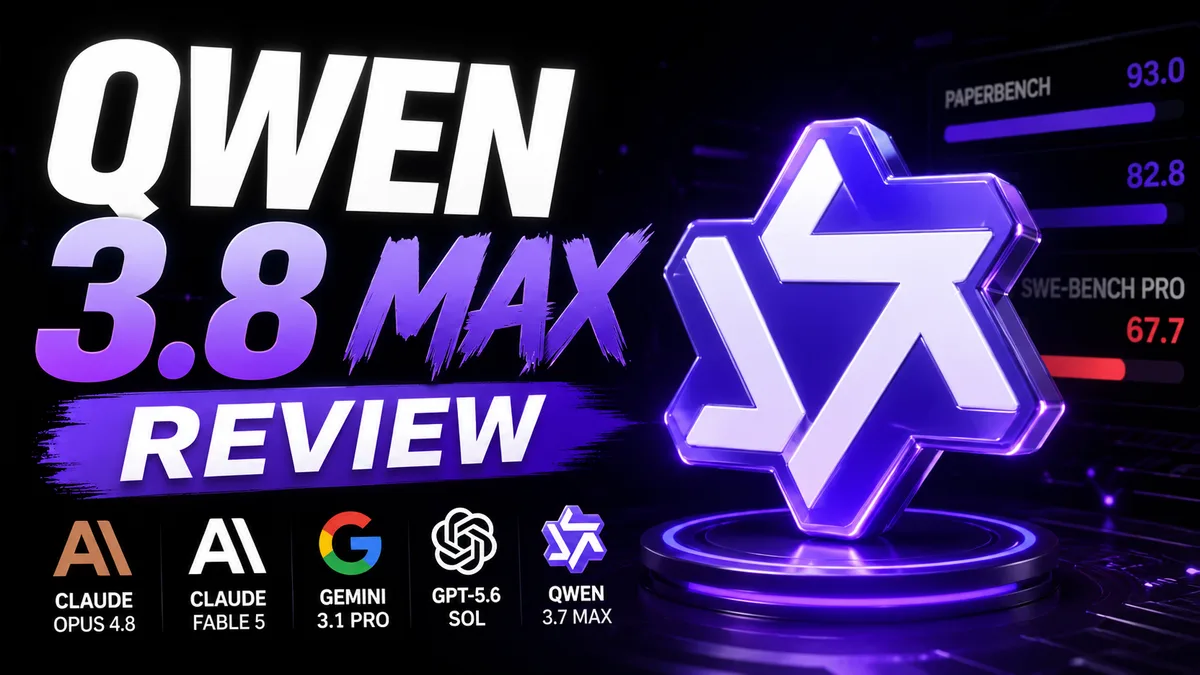
Qwen 3.7 Review: #1 Chinese Lab, Ranked 13th Globally
Qwen 3.7-Max ranks 13th globally on Arena text, 7th in math, and tops every Chinese AI lab. Launched May 20 with a new AI chip. What benchmarks show.
TL;DR
Alibaba officially launched Qwen 3.7-Max and Qwen 3.7-Plus-Preview at the Alibaba Cloud Summit in Hangzhou on May 20, 2026. The preview versions first appeared silently in Qwen Chat on May 19, one day before the summit. Full technical specs and agent benchmarks were revealed at the event.
Qwen 3.7-Max-Preview ranks 13th globally on the LM Arena text leaderboard and 16th in vision. Both are the highest-ranked Chinese AI models on Arena, surpassing every other Chinese lab. They remain slightly behind the top five US models.
Alibaba announced its new in-house AI accelerator chip developed by T-Head. The Zhenwu M890 features 144GB of GPU memory and 800 GB/s bandwidth. It is designed for AI training and inference, with 128 units fitted into the Panjiu AL128 rack-scale server to bypass foreign hardware dependencies.
To prove its agentic reasoning, Qwen 3.7-Max successfully ran a 35-hour autonomous optimization task on the Zhenwu M890, executing over 1,000 tool calls and delivering a 10.0x performance speedup on Triton operator optimization.
At launch, both Max and Plus previews on chat.qwen.ai are locked in deep thinking mode only, with web search and code interpreter temporarily disabled. No open-weight downloads are available yet. Official API access is rolling out on Alibaba Cloud Model Studio.
Qwen 3.6-Max-Preview launched on April 20. Qwen 3.7 arrived 28 days later on May 19-20. This is Alibaba's fastest point-release cadence yet, and it is clearly timed to compete with the pace of GPT-5.4 and Gemini 3.5 Flash releases from April-May.
Alibaba confirmed it will continue releasing open-weight mid-tier models under Apache 2.0, following the pattern of Qwen 3.6-27B and 3.6-35B-A3B. The flagship Max variant is expected to remain proprietary API-only, matching the approach taken with Qwen 3.6-Plus.
Qwen 3.7: Alibaba's New Flagship Ranks #1 in China, Ships Same Day as a New AI Chip
BEIJING, May 20, 2026 - Alibaba Group has expanded its artificial intelligence ambitions with the launch of a new in-house AI accelerator chip and an upgraded large language model, reinforcing China's push to reduce dependence on foreign semiconductor technologies amid tightening US export restrictions.
The announcements came at the Alibaba Cloud Summit in Hangzhou, and the pairing was deliberate. A new chip and a new frontier model on the same stage is not coincidence. It is Alibaba making a statement about where it intends to sit in the global AI infrastructure stack.
Here is everything that was announced, what the benchmark numbers actually show, and what developers should expect over the next two to four weeks.
What Was Announced
Qwen 3.7-Max and Qwen 3.7-Plus-Preview
According to monitoring by Beating, the Alibaba Qwen team quietly launched the first preview versions of the Qwen 3.7 series on chat.qwen.ai on May 19, one day before the summit: Max and Plus. The new versions have been forcibly locked into deep thinking mode, temporarily disabling web search and code interpreter functionalities.
The official technical foundation and commercial deployment plans were then unveiled at the summit on May 20. This is Alibaba's established pattern: soft-launch in the hosted chat product to gather signals, then formalize at a major event.
Alongside the hardware launch, Alibaba introduced Qwen 3.7-Max, the newest version of its flagship Qwen large language model family. The company said the model is engineered for advanced coding, reasoning and long-running AI agent tasks, with support for extended operation without major performance degradation.
The Zhenwu M890 Chip
The Zhenwu M890 is Alibaba's newest AI accelerator chip developed by T-Head for AI training and inference workloads, particularly applications involving autonomous AI agents and large-scale enterprise AI systems. Delivering a threefold (3x) performance increase over its predecessor (Zhenwu 810E), the M890 is built in scaled mass production to provide domestic buyers with a strong alternative to foreign hardware.
The M890 features:
- 144GB of GPU memory
- 800 GB per second interchip bandwidth
Alibaba also announced the Panjiu AL128 server architecture, which combines 128 Zhenwu M890 accelerators into a single rack-scale AI computing platform. Looking ahead, Alibaba mapped out successive generations of in-house silicon: the V900 chip for mid-2027 (roughly tripling M890's performance) and the J900 chip for late 2028.
The Evaluation Numbers: Honest Assessment
In the latest Arena leaderboard for large models, Qwen 3.7 has achieved dual top rankings in China for both text and vision. The flagship model, Qwen3.7-Max-Preview, ranks 13th globally on the text leaderboard, elevating Alibaba Lab's text research ranking to 6th worldwide. The new model has firmly entered the global top 10 across core reasoning benchmarks: 7th in mathematics, 9th in expert prompting and software/IT, and 10th in code generation. The vision-focused Qwen3.7-Plus-Preview secured 16th place globally on the vision leaderboard, raising Alibaba's overall vision research capability to 5th worldwide.
These numbers deserve both celebration and honest context.
On the positive side: 13th globally in text, 7th in mathematics, and 9th in software/IT is a strong Arena showing. These versions surpass other Chinese AI laboratories in several areas, making them the top-ranked Chinese AI models currently based on Arena's evaluations.
At the same time, Alibaba released their official first-party benchmarks alongside the summit. On evaluations measuring hard reasoning and software engineering, Qwen 3.7-Max holds highly competitive standings:
- GPQA Diamond: 92.4 (surpassing Claude Opus-4.6 Max's 91.3)
- Terminal-Bench 2.0-Terminus: 69.7 (beating DeepSeek-V4-Pro-Max's 67.9)
- SWE-bench Pro: 60.6
- SWE-bench Verified: 80.4
On the honest side: they still lag behind top US products, including those from Anthropic, Google, and OpenAI. GPT-5.4 sits higher on Arena text, and Gemini 3.5 Flash has just deployed with solid coding and agentic benchmarks. Qwen 3.7-Max at position 13 is highly competitive but not leading.
The 35-Hour Kernel Optimization Milestone
To demonstrate the agentic reasoning of Qwen 3.7-Max, Alibaba showcased a real-world case study during the summit.
Tasked with optimizing a Triton operator on an ECS instance powered by the newly launched Zhenwu M890 processors-a hardware platform the model had never seen during training-Qwen 3.7-Max ran completely autonomously for 35 hours.
Starting from an empty workspace with only a task description and an evaluation script, the model:
- Executed 1,158 tool calls across 432 kernel evaluations.
- Diagnosed performance bottlenecks, split prefix KV-caches along the token dimension, and removed host-device communication overhead.
- Restructured the operator to share memory loads.
Without human intervention, the agent achieved a 10.0x geometric mean speedup, significantly outperforming GLM 5.1 (7.3x) and Kimi K2.6 (5.0x) on the same task. This serves as a concrete signal of how well the model handles long-horizon, autonomous software engineering workloads.
The 28-Day Cadence Is the Real Story
The previous flagship, Qwen3.6-Max-Preview, was only released on April 20, just 28 days ago, demonstrating an exceptionally rapid product iteration cycle.
Alibaba released Qwen 3.5 in February. Qwen 3.6 in April. Qwen 3.7 in May. That is three major model generations in four months. For context: OpenAI shipped GPT-5.3, GPT-5.4, and GPT-5.5 across roughly the same window. Google shipped Gemini 3.1 Pro and Gemini 3.5 Flash. The competitive intensity at the top of the AI market right now is genuinely without precedent.
What makes Alibaba's cadence notable is that it is happening under hardware constraints. US export controls limit Chinese labs' access to the most advanced foreign chips. Alibaba has been forced to optimize training and inference pipelines for hardware it can actually access. The Zhenwu M890 announcement is part of the long-term answer to that constraint, but the short-term answer has been architectural efficiency, better data pipelines, and faster iteration rather than brute-force compute scaling.
What Is Not Available Yet
Being clear about what you cannot do with Qwen 3.7 today matters as much as knowing what you can.
As of May 20, 2026: no open-weight downloads exist on Hugging Face or the QwenLM GitHub. The model is accessible only through chat.qwen.ai in preview mode. Web search and code interpreter are disabled in the current preview build on the chat interface. Max does not support image input at launch; Plus-Preview handles vision tasks.
Based on the Qwen 3.6 timeline, here is what to expect next:
- API access via Model Studio (Alibaba's model-serving platform) is beginning to roll out for enterprise testers.
- Open-weight mid-tier models, likely equivalent to a 27B dense and a 35B-A3B MoE variant, are expected within two to four weeks under Apache 2.0.
- Full technical reports alongside or shortly after the open-weight release.
The Open-Weight Question
Alibaba's open-source posture has been under scrutiny since March 2026, when Lin Junyang, the head of the Qwen AI model division, resigned following the release of Qwen 3.5 and Qwen 3.5-Plus. He was the third executive to leave Alibaba that year, and the departure raised concerns that the company might shift away from open-source releases under commercial pressure.
Amid concern that this could mean a shift away from research and open-source artificial intelligence, Alibaba said it will continue its focus on open source. Later the same month, a company announcement revealed the formation of a new AI business unit, Alibaba Token Hub. The new unit will supervise AI-related work, led by Alibaba CEO Eddie Wu.
The Qwen 3.6 release validated that commitment: the Qwen3.6-35B-A3B model was released under the Apache 2.0 license. The expectation based on this pattern is that Qwen 3.7 will follow the same structure: proprietary flagship Max available API-only, open-weight mid-tier models under Apache 2.0 for self-hosting. To size hardware for those open-weight releases, see our Qwen 3.6 RAM requirements guide.
For enterprises in regulated industries or teams building with GDPR or data sovereignty requirements, this distinction matters. The flagship API routes through Alibaba Cloud infrastructure under Chinese data regulations. The open-weight mid-tier models, once available, can be self-hosted without that concern.
Vertically Integrated AI: What the Chip and Model Launch Together Signal
The most significant aspect of the May 20 announcement is not the Arena rankings or the chip specifications individually. It is what they represent together.
By developing both AI chips and foundation models internally, Alibaba is building a vertically integrated AI stack that combines cloud infrastructure, semiconductors and enterprise software services.
This is the same strategy that made Apple's transition to its own silicon so consequential: controlling the full stack from hardware to software to application means you can optimize at every layer simultaneously. For Alibaba, the Zhenwu M890 is not just a chip. It is the infrastructure layer that makes it possible to keep shipping new Qwen generations at 28-day cadences without depending on external supply chains or pricing.
The launch aligns with Alibaba's previously announced commitment to invest more than 380 billion yuan ($53 billion) into cloud and AI infrastructure over three years. At that capital commitment level, the M890 and Qwen 3.7 are early components of a multi-year infrastructure buildout that will outlast any single model release.
How Qwen 3.7 Fits the May 2026 Landscape
Qwen 3.7 drops into a week that also contained the Google I/O keynote with Gemini 3.5 Flash. The competitive timing is intentional on both sides.
Gemini 3.5 Flash is available now via API with confirmed benchmarks (91% GPQA Diamond, 72.1% Arena coding) and is already deployed across Google Search and the Gemini app. Qwen 3.7-Max is in preview mode with disabled features, but boasts a strong 92.4% score on GPQA Diamond and 60.6% on SWE-bench Pro.
For developers who need something they can integrate today, Gemini 3.5 Flash or DeepSeek V4-Pro are the practical choices. For developers watching where the open-weight Chinese frontier is heading, Qwen 3.7 is the most important model release of the week.
What to Do Right Now
If you want to test Qwen 3.7 today, you can access it via chat.qwen.ai. Keep in mind the current limitations: deep thinking mode only, no web search, no code interpreter, no image input on Max. Treat the current preview as a capability signal, not a production-ready tool.
If you need open weights for self-hosting or API access for production, wait two to four weeks for the official release that follows the summit. That is when the Qwen 3.7 models that actually matter for development work will be available.
Compare Qwen 3.7 Against Other Frontier Models
Wondering how Qwen 3.7-Max stacks up against GPT-5.4, Gemini 3.5 Flash, Claude Opus, and DeepSeek V4-Pro on the benchmarks that matter for your workflow?
Compare AI models on Renovate QR
The /tools directory is updated as new benchmark data arrives. We will add Qwen 3.7 official benchmarks as soon as they are published alongside the open-weight release.
Published May 20, 2026. This article will be updated when official API access, open-weight downloads, and standardized benchmark scores are published by Alibaba following the Cloud Summit.
Sources & References
- Alibaba Qwen, for Qwen 3.7 release notes
- Qwen Chat, for live model access
Frequently Asked Questions
What is Qwen 3.7 and when was it officially released?
Qwen 3.7 is Alibaba's latest generation of flagship AI models, officially announced at the Alibaba Cloud Summit in Hangzhou on May 20, 2026. Preview versions named Qwen3.7-Max-Preview and Qwen3.7-Plus-Preview first appeared in Qwen Chat on May 19, 2026, one day before the official summit reveal. The Max model is engineered for advanced coding, reasoning, and long-running AI agent tasks. The Plus model focuses on vision and multimodal capabilities.
How does Qwen 3.7-Max rank compared to GPT-5.4 and Claude Opus?
Qwen 3.7-Max-Preview ranks 13th globally on the LM Arena text leaderboard. On reasoning-heavy benchmarks, it scores 92.4 on GPQA Diamond and 69.7 on Terminal-Bench 2.0-Terminus, placing it in direct competition with models like Claude Opus-4.6 Max and DeepSeek V4-Pro-Max. While Qwen 3.7 is the highest-ranked Chinese AI model on Arena and surpasses other domestic labs, it remains highly competitive with, though slightly behind, the top US frontier systems.
What is the Zhenwu M890 chip Alibaba announced?
The Zhenwu M890 is Alibaba's new in-house AI accelerator chip, developed by its semiconductor subsidiary T-Head. Delivering a threefold (3x) performance increase over its predecessor (Zhenwu 810E), it boasts 144GB of GPU memory and 800 GB/sec interchip bandwidth. It is designed to handle memory-heavy and real-time communication demands for autonomous AI agents. Alibaba announced the Panjiu AL128 server architecture that combines 128 Zhenwu M890 chips into a single rack-scale platform.
Are there official standardized benchmarks for Qwen 3.7?
Yes. In Alibaba's official launch documentation, Qwen 3.7-Max scored 92.4 on GPQA Diamond (outperforming Claude Opus-4.6's 91.3), 60.6 on SWE-bench Pro, and 69.7 on Terminal-Bench 2.0-Terminus (outperforming DeepSeek-V4-Pro-Max at 67.9). It also scored 80.4 on SWE-bench Verified and 79.1 on the IFBench instruction-following test.
Can I download Qwen 3.7 weights right now?
No, not yet. As of May 20, 2026, there are no open-weight downloads for Qwen 3.7 on Hugging Face or GitHub. Current access is through chat.qwen.ai in preview mode, and official API access via Alibaba Cloud Model Studio is beginning to roll out. Open-weight mid-tier models (equivalent to Qwen 3.6-27B and 3.6-35B-A3B) are expected within two to four weeks, likely under the Apache 2.0 license.
What are the current limitations of Qwen 3.7 at launch?
At launch, both Qwen 3.7-Max-Preview and Plus-Preview are locked in deep thinking mode only on chat.qwen.ai. Web search and code interpreter are temporarily disabled in the preview versions. The Max model does not currently support image input; use Plus-Preview for vision tasks. No open weights are available.
Is Qwen 3.7 open source?
The flagship Max variant is expected to be proprietary API-only, following the pattern Alibaba established with Qwen 3.6-Plus and Qwen 3.6-Max. However, Alibaba has confirmed it will continue releasing open-weight mid-tier models under Apache 2.0. Based on the Qwen 3.6 pattern, a 27B dense model and a MoE variant (likely 35B-A3B equivalent) are the most likely open releases. Alibaba CEO Eddie Wu reaffirmed the company's commitment to open source in March 2026 after concerns arose following the departure of the Qwen division head Lin Junyang.
Renovate QR Newsletter
Stay sharp on AI & tech
Our best reviews, comparisons, and guides — delivered weekly. No noise, no spam.