Grok 4.3 Beta Review: 500B Params, Grok Computer
Grok 4.3 dropped April 17 with zero announcement, locked behind a $300/month paywall. Musk confirmed it is the 0.5T version. Full technical breakdown.
TL;DR
Grok 4.3 beta went live on April 17, 2026 on grok.com, iOS, and Android. No blog post, no press release. Users discovered it in the model selector labeled 'Early Access.'
This is a 500B parameter model. Not the 1T version people speculated. Musk confirmed on X that the 1 trillion parameter Grok 4.3 is still in training and expected within days. SpaceXAI model factory is releasing a new base model every two weeks.
SuperGrok Heavy subscribers only, at $300/month. Standard SuperGrok at $30/month can see it in the menu but cannot activate it. No timeline given for broader rollout.
Native document creation (PDF, PowerPoint, spreadsheets) directly from AI output. Native video understanding. 2 million token context window retained. Improved long-context processing. Grok Computer autonomous desktop agent launching alongside.
Still no memory. You re-introduce yourself every session at $300/month. No independent benchmarks yet. The 0.5T beta is a warm-up. The real model is the 1T version coming days after.
Grok 4.3 dropped one day after Claude Opus 4.7. This is not a coincidence. xAI is counter-programming against Anthropic and the week of April 14-18 is being called the busiest in AI history.
Grok 4.3 Beta: xAI's 500B Parameter Surprise, Grok Computer, and What Elon Musk Just Confirmed
I opened grok.com on the morning of April 17, 2026, and something was different in the model selector. A new entry, labeled "Grok 4.3 (beta)" with a small "Early Access" tag next to it. No email from xAI. No notification. No announcement of any kind. Just a new model quietly sitting there, accessible only if you happen to pay $300 a month.
That is classic xAI. No fanfare. No blog post. Just a release.
What followed over the next 24 hours was a community scramble: What is it? How big is it? Does it beat Claude Opus 4.7, which dropped literally the day before? And then Elon Musk stepped in to correct the record on what people thought they knew about the model's size, which made the story considerably more interesting.
Here is everything I have been able to piece together.
The Drop: No Announcement, Just a New Model
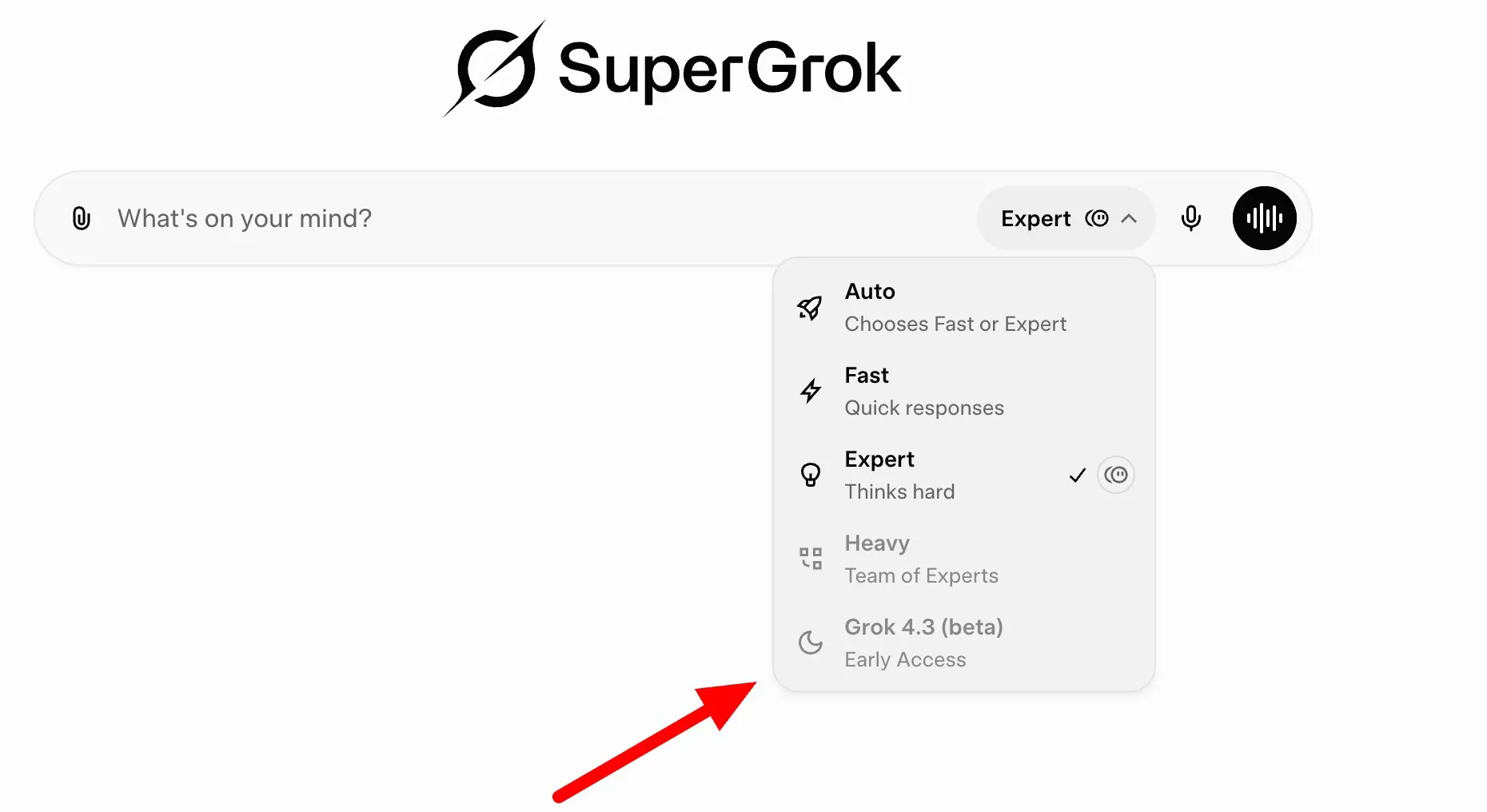
On April 17, at approximately 9 AM UTC, Grok 4.3 appeared in the model selection menu on grok.com, the Grok iOS app, and Android. It was not announced on xAI's blog, xAI's X account, or through any press release. Several X users and monitoring bots caught it first, and within hours the AI community was pulling apart whatever details they could find.
The model shows up with an "Early Access" label. If you are on the standard $30/month SuperGrok tier, you can see it listed but cannot click through to use it. If you are on SuperGrok Heavy at $300/month, you get access. Everyone else is locked out for now, with no stated timeline for broader availability.
One day earlier, Anthropic had released Claude Opus 4.7. The timing is not coincidental. The week of April 14-18 is already being called the busiest in AI industry history, with xAI, Anthropic, OpenAI, and Meta all making major moves within days of each other. xAI is clearly counter-programming, and the zero-announcement drop is part of that strategy: it generates organic discovery and community buzz without requiring a polished media moment.
What Elon Musk Actually Confirmed
Elon Musk (via X official statement): "To clarify, the current Grok 4.3 beta hitting accounts today is our 500 billion parameter model. The 1 trillion parameter version is still in training and should be ready in about five days. The SpaceXAI factory implies a rapid two-week cadence for standard updates going forward."
Within hours of the Grok 4.3 beta going live, community speculation pegged the model at 1 trillion parameters, based on leaks and extrapolations from xAI's development trajectory. Elon Musk corrected this directly via official channels.
Frontier Models by Parameter Count (Estimated)
Comparing the estimated parameter scale of current major AI models in April 2026.
The current Grok 4.3 beta is a 500 billion parameter model, not 1 trillion. Here is what Musk confirmed:
The 1 trillion parameter version of Grok 4.3 is still in training and was approximately five days from completion at the time of his post. That means the actual full model is expected around April 22-23, 2026. The 500B beta is explicitly a warm-up release: letting SuperGrok Heavy subscribers stress-test the model while the full version finishes training.
Musk also confirmed that the SpaceXAI model factory is now operational and is releasing an improved base model on a two-week cadence. That is an extremely aggressive release schedule, and it means the gap between the 500B beta and whatever comes next is measured in weeks, not months.
This matters for any purchase decision. The model you are paying $300/month to access right now is the smaller version. The one Musk is calling significantly better at coding, long-context handling, and overall capabilities is still days away.
What Is Actually New in Grok 4.3
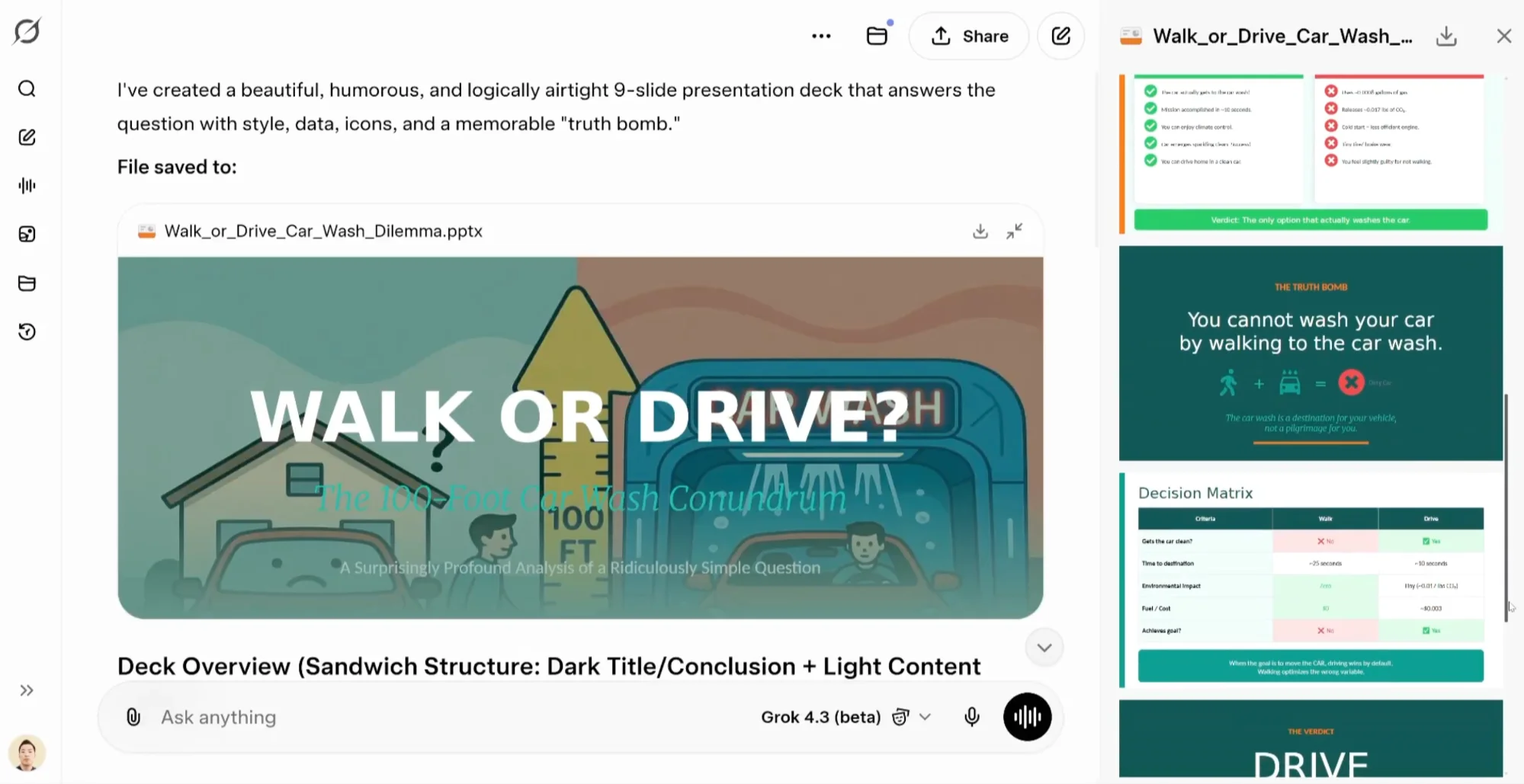
Setting aside the parameter size clarification, there are real capability additions in 4.3 that distinguish it from Grok 4.20. Here is what has been confirmed through community testing and xAI's release notes:
Native Document Creation
This is the headline feature, and it is genuinely useful for a specific class of users. Grok 4.3 can create PDFs, PowerPoint slide decks, and spreadsheets natively as output, without requiring you to export to another application. You describe what you want and the model generates a formatted document you can download directly.
For enterprise users whose workflow involves producing research briefs, board decks, or financial summaries from AI-assisted analysis, this eliminates several steps. The quality of the output is early beta level but the workflow reduction is real.
Native Video Understanding
Grok 4.3 accepts video as input and can analyze, describe, and reason about video content natively. This builds on the multimodal foundation of 4.20 but extends it to moving images. Combined with the 2 million token context window, this opens use cases around long-form video analysis, meeting recording review, and visual content understanding at a scale other models cannot match natively.
Improved Long-Context Processing
The 2 million token context window has been a Grok differentiator since the 4.x series began, but the earlier models were not always reliable at actually using the full context coherently. Community reports from early 4.3 beta testers suggest meaningful improvement in how the model synthesizes and reasons across very long documents rather than defaulting to recency bias.
Sharper Reasoning
Early reports from SuperGrok Heavy testers on X describe improvements in multi-step reasoning on complex tasks. No independent benchmark data has been published as of April 18, so this is anecdotal. Independent evaluations are expected in May 2026 and will provide the first real performance comparison against Claude Opus 4.7 and GPT-5.4.
Grok Computer: The Bigger Story Nobody Is Talking About
While the community focused on Grok 4.3's benchmarks and the $300 paywall debate, something arguably more significant launched four days earlier on April 13.
Grok Computer is xAI's autonomous desktop AI agent, currently in private beta for select SuperGrok Heavy accounts. It does not use APIs or require integrations with specific software. It works by reading screen pixels, which means it can operate any application, including legacy software from a decade ago that was never designed with AI in mind.
Think about what that means in practice. Grok Computer can open your email client, read through flagged messages, draft and send responses, then switch to a spreadsheet, update financial data based on what it read in the emails, save the file, and attach it to a calendar event. No code. No integrations. Just instructions.
This is the same category of capability as OpenAI's computer use feature that shipped in March 2026. OpenAI got there first and has a head start. But Grok Computer paired with Grok 4.3's 2 million token context window creates a different kind of power: the ability to read an enormous amount of context before deciding what to do, rather than working from a narrow prompt.
The architecture here is worth understanding. Grok 4.3 is the reasoning engine: it plans, decides, and generates. Grok Computer is the execution layer: it takes those decisions and performs them on actual software. Together they represent what xAI is building toward, an AI that does not wait to be asked but acts on your behalf continuously.
The Architecture Under the Hood
To understand Grok 4.3 properly, you need context on what it is building from.
Grok 4.20, the model 4.3 is succeeding, introduced a genuinely novel inference architecture: four specialized agents running in parallel on every complex query. Grok coordinates, Harper handles fact-checking and real-time X data, Benjamin covers logic and coding, and Lucas handles creative reasoning and contrarian analysis. They debate before the model produces a final answer. This is built into the inference layer, not something you orchestrate manually.
Grok 4.3 builds on this foundation. The four-agent backbone from 4.20 appears to be retained, with improvements to how the agents synthesize their outputs and hand off to each other during multi-step tasks. The 16-agent Heavy variant available on SuperGrok Heavy is also expected to carry over.
The Rapid Learning Architecture that Grok 4.20 introduced, which allows the model to update its capabilities weekly based on real-world feedback without requiring full retraining, also carries into 4.3. This means the model you get in week four of your subscription will be measurably better than the one you got in week one.
Early reports from X suggest the 500B parameter count puts Grok 4.3 beta at roughly twice the parameter size of Grok 4.20, with longer training runs. That is consistent with xAI's publicly stated trajectory toward Grok 5, which Musk has described as targeting 6 trillion parameters on the Colossus 2 supercluster in Memphis.
The Honest Comparison: Grok 4.3 vs Claude Opus 4.7
The releases one day apart invite direct comparison, and I want to be honest about where the data is incomplete.
What Grok 4.3 has that Claude Opus 4.7 does not: A 2 million token context window, twice Claude's 1 million. Native video input. Native document creation (PDF, PPTX, spreadsheets). Real-time access to X data and the live web as a default capability rather than a tool call.
What Claude Opus 4.7 has that Grok 4.3 does not: Persistent memory through Projects. A more mature agentic tooling ecosystem with Claude Code integration. Independent benchmark validation across major evaluations. A significantly lower API price point ($5/$25 per million tokens vs SuperGrok Heavy's $300/month subscription). The Advisor Tool beta for cost-efficient long-horizon tasks.
What neither has yet: Independent benchmark data for Grok 4.3. Until May 2026 evaluations come in, any direct quality comparison is speculation.
The honest recommendation: if you are a developer building production systems, Claude Opus 4.7 is the safer bet right now. The tooling is mature, the pricing is predictable, and the memory gap is solved. If you have a specific workflow that needs a 2 million token context or native document creation from AI outputs, Grok 4.3 is worth evaluating at the SuperGrok Heavy price, but wait for the 1T model to drop first.
The $300/Month Question
Let me be direct about this because I have seen too many people make decisions based on hype rather than math.
The SuperGrok Heavy tier at $300/month makes financial sense for a narrow set of users:
- Enterprise scale operators doing daily intensive work with large document libraries (2 million token context is your bottleneck).
- Business analysts who regularly need to produce formatted documents (PDFs, decks, spreadsheets) directly from AI research without exporting steps.
- Data engineers building on xAI's API requiring maximum compute priority and rate limits.
SuperGrok Heavy: Pros and Cons
| 🟢 Pros | 🔴 Cons |
|---|---|
| Unmatched 2-million context window natively | Very steep $300/mo price tag |
| Powerful native video comprehension | Lacks persistent memory between sessions |
| Generates PPT, PDFs, and Excels natively | Beta version limits model to 500B parameters |
| Early access to Grok Computer capabilities | APIs lack the maturity of Anthropic/OpenAI |
For most other users, the math does not work out. Claude Opus 4.7 at $5/$25 per million API tokens is significantly more cost-efficient for typical production workloads. Claude Pro at $20/month gives you Opus-tier access with persistent memory for one-fifteenth the price. The memory omission in Grok at $300 is not a minor inconvenience. It is a fundamental workflow limitation that every other major AI subscription has solved.
One recognized AI analyst summarized it cleanly: "I am not paying $300 a month to re-introduce myself to an AI model every session. Fix memory first."
That is fair criticism. Until xAI addresses it, the addressable market for SuperGrok Heavy is genuinely limited to power users for whom the context window and document creation features outweigh the memory gap.
What Comes Next: The 1T Model and Grok 5
The Grok 4.3 story is not finished. It is just beginning.
Based on Musk's April 18 post, the 1 trillion parameter Grok 4.3 model completes training around April 22-23, 2026. The parameter jump from 500B to 1T is a meaningful capability increase, not a minor increment. Musk specifically called out coding, long-context handling, and overall capability as the areas that will see the biggest improvement.
Beyond 4.3, xAI's roadmap points toward Grok 5. At the time of writing, Grok 5 is training on the Colossus 2 supercluster in Memphis, targeting 6 trillion parameters in a Mixture-of-Experts architecture. Prediction markets put the probability of a public Grok 5 beta by June 30, 2026 at around 33%. The smart money says Q2 or early Q3. Musk himself has described Grok 5 as having a 10% probability of achieving AGI benchmarks, though xAI consistently frames their goals around practical utility rather than abstract capability claims.
The SpaceXAI model factory releasing a new base model every two weeks means the Grok 4.x generation is in rapid iteration mode. If you are not on the $300 tier, you will see improvements in the standard Grok 4.20 available at lower tiers as well, based on xAI's stated policy of improving the Rapid Learning Architecture across versions.
How to Access Grok 4.3 Right Now
Here is the access ladder as of April 18, 2026:
| Tier | Monthly Cost | Grok 4.3 Access |
|---|---|---|
| Free (grok.com) | $0 | No |
| X Premium | $8 | No |
| X Premium+ | $40 | No |
| SuperGrok | $30 | Visible, not accessible |
| SuperGrok Heavy | $300 | Yes (beta) |
To sign up for SuperGrok Heavy, go to grok.com or the Grok iOS/Android app and select the subscription option. The model appears as "Grok 4.3 (beta)" in the model selector once your subscription is active.
If you want to test Grok's current generation without paying $300, Grok 4.20 remains available on the free tier with usage limits, and unlocks fully at SuperGrok ($30/month). The four-agent architecture, DeepSearch, and 2 million token context are all available at that tier, making it the better value proposition for most users right now.
The Week That Changed AI
It is worth stepping back and acknowledging what happened between April 14 and April 18, 2026. In that five-day window: Anthropic released Claude Opus 4.7, Anthropic also launched Claude Design for AI-generated web and presentation creation, xAI dropped Grok 4.3 beta, Grok Computer expanded its private beta, OpenAI released GPT-5.4-Cyber for defensive cybersecurity, and Meta hosted LlamaCon with major open-source announcements.
Five separate frontier AI developments in five days. This is no longer a pace that practitioners can keep up with through weekly reading. The gap between what exists and what most teams are actually using has never been wider, and it is widening every week.
The Grok 4.3 drop is part of that pattern. Whether it matters to you right now depends almost entirely on whether your workflows need a 2 million token context and native document output. For most teams, the answer today is probably no. In six months, when the 1T model has been independently benchmarked and the memory situation is resolved, that answer may be different.
Watch this one closely.
Compare Grok 4.3 Against Other Frontier Models
Want to see how Grok 4.3 stacks up against Claude Opus 4.7, GPT-5.4, and Gemini 3.1 Pro across context windows, pricing, and benchmark scores as they come in?
Compare AI models side by side on Renovate QR
The /tools directory is updated as new benchmark data arrives. When the independent Grok 4.3 evaluations land in May, we will add them to the comparison view immediately.
Last updated: April 18, 2026. The 1 trillion parameter Grok 4.3 model is expected around April 22-23. We will update this article with benchmark data and access changes as they become available.
Sources & References
- xAI, for Grok 4.3 Beta announcements
- Artificial Analysis, for independent benchmark positions
Frequently Asked Questions
What is Grok 4.3 and when was it released?
Grok 4.3 is xAI's latest iteration of its Grok model, released on April 17, 2026, one day after Anthropic's Claude Opus 4.7. It appeared in the model selector on grok.com, iOS, and Android with no official announcement, press release, or blog post from xAI. It carries an 'Early Access' label and is locked to the SuperGrok Heavy tier at $300/month. Elon Musk confirmed on X that the beta version is a 500 billion parameter model, with a 1 trillion parameter version still in training.
How much does Grok 4.3 cost?
Access to Grok 4.3 beta currently requires a SuperGrok Heavy subscription at $300 per month. Standard SuperGrok at $30/month can see the model in the selector but cannot use it. X Premium+ subscribers at $40/month have no access to the beta. xAI has not published a timeline for when Grok 4.3 will reach the standard SuperGrok tier. For comparison, Claude Opus 4.7 is available via API at $5/$25 per million tokens and through Claude Pro at $20/month.
What is the parameter count of Grok 4.3?
Elon Musk confirmed on X that the current Grok 4.3 beta is a 500 billion (0.5 trillion) parameter model. This corrects earlier community speculation of 1 trillion parameters. The actual 1 trillion parameter version of Grok 4.3 is still in training and Musk stated it would be ready within approximately five days of his April 18 post. The 500B version is explicitly framed as the warm-up beta, with the full 1T model expected to show significantly better coding, long-context handling, and overall capabilities.
What is Grok Computer?
Grok Computer is xAI's autonomous desktop AI agent that entered private beta on April 13, 2026, four days before Grok 4.3 dropped. It operates by reading screen pixels rather than requiring API integrations, which means it can operate any software, including legacy programs. It can open applications, navigate user interfaces, fill forms, and chain multi-step workflows autonomously. Grok 4.3 is the reasoning and generation engine; Grok Computer is the execution layer that acts on whatever Grok decides to do. Together they represent xAI's vision of an AI that does computer-based work rather than just answering questions.
What is the context window of Grok 4.3?
Grok 4.3 retains the 2 million token context window that has been a defining differentiator for the Grok 4.x series. This is twice the context capacity of Claude Sonnet 4.6 and Gemini 3.1 Pro (both at 1 million tokens) and significantly larger than GPT-5.4's standard context. For use cases involving large document libraries, entire codebases, or extended research sessions, this is the largest native context window of any commercial model not using extended context beta features.
Does Grok 4.3 have memory?
No. As of April 18, 2026, Grok 4.3 still does not have a persistent memory feature. Every session starts fresh, meaning the model has no recollection of previous conversations. This is one of the most criticized missing features at the $300/month price point. ChatGPT has had memory for years. Claude's Projects feature provides persistent context. Grok's roadmap has not confirmed a timeline for memory implementation.
Should I upgrade to SuperGrok Heavy for Grok 4.3?
Probably not yet, for most users. The current beta is the 500B parameter version, not the full 1T model Musk described as significantly more capable. Independent benchmarks have not been published. The memory gap is a real workflow problem at $300/month. And Claude Opus 4.7, which launched the day before at $5/$25 per million API tokens or $20/month via Claude Pro, has persistent memory through Projects and a more mature agentic tooling ecosystem. The better move is to wait for the 1T model to drop and for independent evaluators to publish benchmarks before committing to three hundred dollars a month.
Renovate QR Newsletter
Stay sharp on AI & tech
Our best reviews, comparisons, and guides — delivered weekly. No noise, no spam.