Claude Opus 4.8: Coding Upgrades, 3x Cheaper Fast Mode
Claude Opus 4.8 launched: upgrades in coding, reasoning, and agentic computer use, plus effort controls, dynamic workflows, and 3x cheaper fast mode.
TL;DR
The latest flagship update from Anthropic boosts performance in agentic coding, multidisciplinary reasoning, and knowledge tasks. It is available today for the same price of $15 per million input tokens and $75 per million output tokens.
Anthropic designed Opus 4.8 to be around four times less likely than Opus 4.7 to let bugs or incorrect code slide without notifying the developer, addressing a major issue with prior agent evaluations.
Users can now manually control how much thinking and compute Claude puts into a response. Higher effort lets the model think deeper, while lower effort speeds up answers and limits rate throttling.
A research preview feature allows Claude to spin up and coordinate hundreds of parallel subagents in one session, automatically refactoring, testing, and verifying massive codebases.
Running Opus 4.8 in fast mode (delivering roughly 2.5x speed) now costs $10 per million input and $50 per million output tokens, a 3x discount compared to fast mode for previous versions.
Anthropic confirmed they are working on bringing their highly secure, cybersecurity-focused Mythos-class models to wider general availability in the coming weeks.
Anthropic Releases Claude Opus 4.8
Anthropic released Claude Opus 4.8 on May 28, 2026, delivering an upgrade to its flagship model. This update focuses heavily on agentic reliability, codebase-scale planning, and improved honesty in development environments. The update arrives during a period of intense competition among frontier model labs, as teams look beyond simple version numbers and prioritize practical workflow integration.
I watched the announcement closely and analyzed the technical system card. Here is what Opus 4.8 brings to the table, how its benchmarks stack up against GPT-5.5 and Gemini 3.1 Pro, and what the update means for real-world development.
Claude Opus 4.8 Benchmarks: A Closer Look
The headline of this release is the progress Opus 4.8 shows across agentic, coding, and multidisciplinary reasoning tests. Anthropic's comparison highlights how the new model performs relative to its predecessor and its primary competitors:
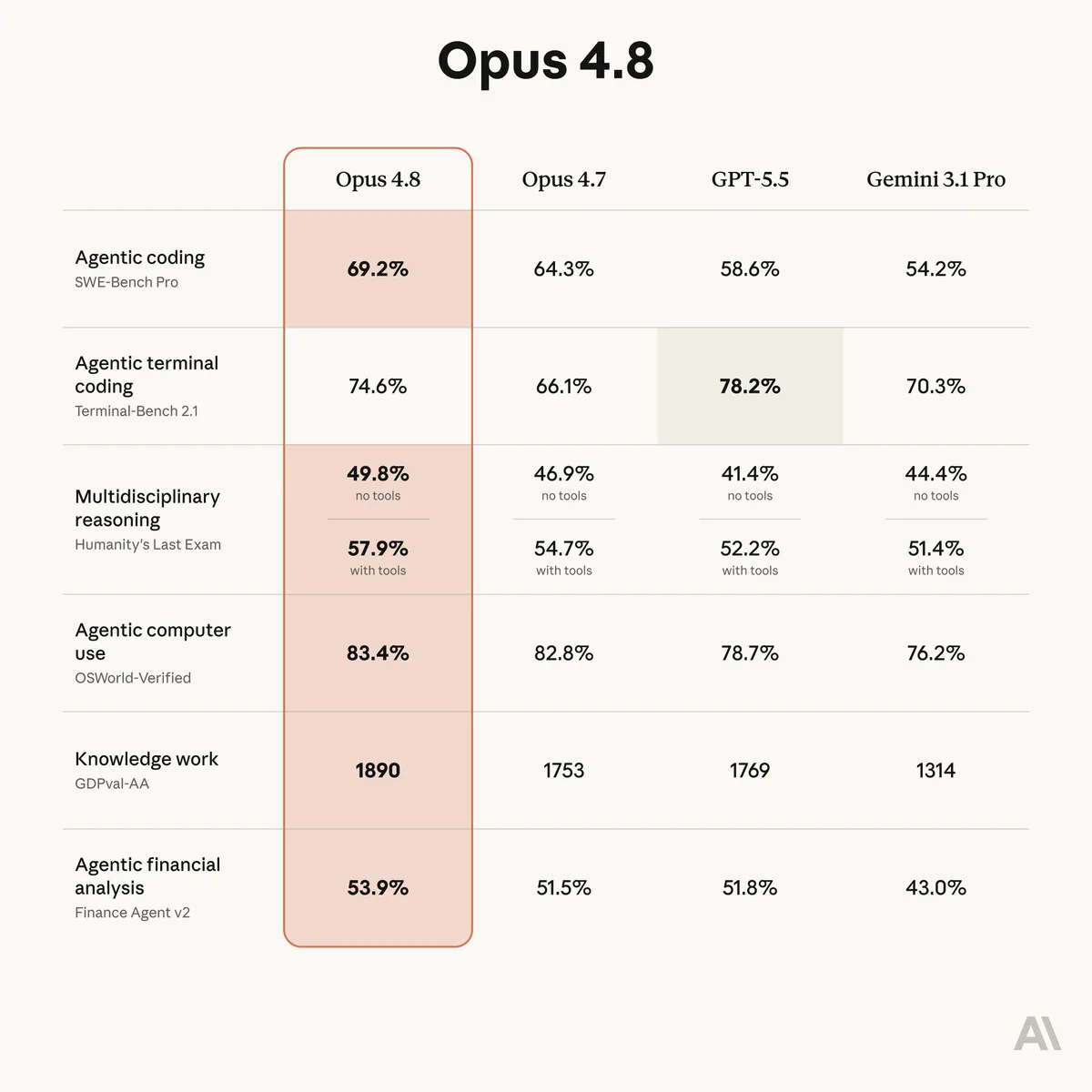
Looking at the data, Opus 4.8 secures clear leads in several categories, though there are notable exceptions:
Agentic Coding (SWE-Bench Pro)
Opus 4.8 achieves 69.2%, which is a step forward from the 64.3% scored by Opus 4.7. This score also places it ahead of GPT-5.5 (58.6%) and Gemini 3.1 Pro (54.2%). SWE-Bench Pro is notoriously difficult, requiring models to solve real-world GitHub issues in complex repositories. The increase suggests that Opus 4.8 has a better grasp of large-context codebases.
Agentic Terminal Coding (Terminal-Bench 2.1)
This is one area where OpenAI retains its advantage. GPT-5.5 leads the board with 78.2%. Opus 4.8 marks a gain over Opus 4.7 (moving from 66.1% to 74.6%), but it remains in second place. Gemini 3.1 Pro trails at 70.3%.
Multidisciplinary Reasoning (Humanity's Last Exam)
On this highly challenging academic and scientific benchmark, Opus 4.8 scores 49.8% without tools and 57.9% when equipped with external tools. In comparison, GPT-5.5 registers 41.4% without tools and 52.2% with tools. This indicates that Anthropic's flagship remains capable at deep academic reasoning.
Agentic Computer Use (OSWorld-Verified)
Computer use has been a major focus for Anthropic since early v4 models. Opus 4.8 reaches 83.4%, which is slightly ahead of Opus 4.7 (82.8%) and outpaces GPT-5.5 (78.7%) and Gemini 3.1 Pro (76.2%).
Knowledge Work and Finance
On GDPval-AA, a benchmark measuring professional knowledge work, Opus 4.8 scores 1890, representing a gain over GPT-5.5 (1769) and Opus 4.7 (1753). Similarly, on Finance Agent v2, Opus 4.8 leads with 53.9%, followed closely by GPT-5.5 at 51.8% and Opus 4.7 at 51.5%.
The Focus on Honesty: Fewer Faked Answers
While percentage gains on benchmarks are useful, developers often note that frontier models output broken code or fabricate facts when uncertain. Anthropic claims that Opus 4.8 represents a shift in alignment and honesty.
According to Anthropic's evaluations, Opus 4.8 is roughly four times less likely than Opus 4.7 to let flaws in code it writes pass without notifying the user. When the model is uncertain about a particular command, libraries, or system paths, it is designed to explicitly state its uncertainty rather than guessing.
Early feedback from testers indicates a better signal to noise ratio in long-running analysis. When processing complex data spreadsheets or documents, the model proactively flags input discrepancies or potential gaps in the source data. This is an important improvement for enterprise teams relying on autonomous data pipelines.
Effort Controls: Choosing Between Speed and Depth
Anthropic is introducing a new user-facing feature on Claude.ai called Effort Controls. This setting allows users to decide exactly how much cognitive work Claude should dedicate to a response.
Previously, Claude's thinking process was dynamic and determined entirely by the system. With this update, users can toggle between different modes:
- High Effort: This is the default mode for Opus 4.8. It instructs the model to think more frequently and deeply before generating a response. It is optimized for complex code refactoring, logic puzzles, and deep research.
- Low Effort: This setting prioritizes speed. By reducing the thinking steps, the model responds significantly faster and consumes fewer compute resources, making it less likely for power users to hit rate caps.
This control structure matches the industry trend of allowing users to choose between immediate chat answers and slower, more thoughtful reasoning loops.
Dynamic Workflows in Claude Code
Alongside the model update, Anthropic introduced a research preview called Dynamic Workflows inside Claude Code. This feature is aimed at handling massive engineering tasks, such as codebase migrations across hundreds of thousands of lines of code.
Instead of working from a static plan, Claude Code can now spin up and manage hundreds of parallel subagents in a single session. These subagents operate under the main driver, executing specialized tasks, testing code segments, and self-verifying outputs. If a subagent encounters an unexpected error or bad assumption, it can adjust its priorities on the fly and report back with a corrected plan.
For developers managing large enterprise software systems, this dynamic coordination could reduce the hands-on oversight required during major updates.
Stable Base Pricing and a Cheaper Fast Mode
Enterprise buyers will note that standard pricing for Claude Opus 4.8 remains unchanged from Opus 4.7:
- Input Tokens: $15 per million tokens
- Output Tokens: $75 per million tokens
However, Anthropic has reduced the cost of Fast Mode, which runs the model at approximately 2.5 times its standard speed. Running Opus 4.8 in Fast Mode is now three times cheaper than it was for previous iterations, costing:
- Fast Mode Input: $10 per million tokens
- Fast Mode Output: $50 per million tokens
This price reduction makes high speed, high intelligence agentic runs far more economical for production-scale developer workflows.
Looking Ahead: The Mythos 1 Rollout
While Opus 4.8 represents the current state of the art for Anthropic's flagship models, the company also teased what is coming next.
Anthropic confirmed that they are actively preparing to bring their Mythos-class models to wider general availability in the coming weeks. Currently, Mythos 1 is in a limited preview focused strictly on cybersecurity use cases under Project Glasswing, where it has been helping security teams identify critical software vulnerabilities. When Mythos-class models roll out more broadly, they will likely challenge the competitive landscape even further.
Professional Take: Where This Fits in the Ecosystem
The launch of Claude Opus 4.8 shows Anthropic focusing on operational reliability over massive model jumps. While the percentage gains on benchmarks like GDPval-AA and SWE-Bench Pro are steady, the real story is the reduction in hallucinated code and the addition of agentic orchestration through Dynamic Workflows.
In the current ecosystem, GPT-5.5 still maintains an edge in terminal-based environments, but Opus 4.8 establishes itself as a strong option for complex planning, long-term reasoning, and software engineering.
Compare Claude Opus 4.8 Against Other Frontier Models
Want to see how Claude Opus 4.8 compares to GPT-5.5, Gemini 3.1 Pro, and other frontier models on specific benchmarks?
Compare AI models on Renovate QR
The /tools directory is updated continuously as new evaluation data is released.
Published May 28, 2026. All benchmark data and feature details are sourced from Anthropic's official announcements and system card documentation.
Sources & References
- Anthropic Claude Opus, for Opus model documentation
- Anthropic News, for the Opus 4.8 release announcement
- Claude API pricing, for token pricing and fast mode details
Frequently Asked Questions
What are the main benchmark improvements for Claude Opus 4.8?
Claude Opus 4.8 outperforms prior models in several categories. On agentic coding (SWE-Bench Pro), it scores 69.2%, beating Opus 4.7 (64.3%), GPT-5.5 (58.6%), and Gemini 3.1 Pro (54.2%). For multidisciplinary reasoning on Humanity's Last Exam, it scores 49.8% without tools and 57.9% with tools. It also leads in agentic computer use on OSWorld-Verified (83.4%) and knowledge work on GDPval-AA (1890). Its only notable second-place finish is on Terminal-Bench 2.1 (74.6%), where GPT-5.5 still holds the lead at 78.2%.
How does the new Effort Control feature work on Claude.ai?
Effort control gives users direct power over Claude's reasoning depth. Instead of an adaptive model that guesses the required depth, users can explicitly choose the setting. High effort directs Claude to think more frequently and deeply before answering, which is ideal for complex reasoning. Low effort prioritizes speed and uses fewer compute resources, helping users avoid hitting prompt and token caps quickly.
What is Dynamic Workflows in Claude Code?
Dynamic Workflows is a new research preview feature in Claude Code designed for massive tasks like codebase migrations. It allows Claude to spin up and manage hundreds of parallel subagents during a single session. These subagents generate plans, execute work, and self-verify their outputs before reporting back. This lets the AI adapt its priorities on the fly as it uncovers new facts in a codebase.
How much does Claude Opus 4.8 cost to use?
Claude Opus 4.8 keeps the same base pricing structure as its predecessor, Opus 4.7, at $15 per million input tokens and $75 per million output tokens. However, the 2.5x fast mode is now three times cheaper than it was previously, costing $10 per million input and $50 per million output tokens.
What is the focus of the honesty improvements in Opus 4.8?
Anthropic designed Claude Opus 4.8 with a stronger focus on transparency and self-correction. The model is approximately four times less likely than Opus 4.7 to allow buggy code to pass without flagging the issue to the developer. It is also better at proactively highlighting potential discrepancies or bad assumptions in data analysis rather than leaving them for the user to discover.
What is Anthropic Mythos 1 and when is it coming?
Mythos 1 is Anthropic's unreleased, cybersecurity-focused frontier model. It has been used under Project Glasswing to help security teams and open-source developers discover critical system vulnerabilities. While Opus 4.8 is the latest general flagship model, Anthropic indicated that Mythos-class models are expected to enter general availability in the coming weeks.
Renovate QR Newsletter
Stay sharp on AI & tech
Our best reviews, comparisons, and guides — delivered weekly. No noise, no spam.