NVIDIA NemoClaw: The Security Layer for OpenClaw
NemoClaw is not an OpenClaw competitor: it is the governance layer the industry has been waiting for. What it does, why it matters, who should evaluate it.
TL;DR
If you are an individual developer, stay with OpenClaw. If you are a CTO or IT Manager, you should be auditing NemoClaw today for a Q3 rollout. It is the controlled environment that stops a self-evolving agent from bricking your server or leaking your tokens.
NemoClaw is the governance layer for OpenClaw. Jensen Huang described OpenClaw as the OS for personal AI and NemoClaw as the secure kernel it runs on. It uses the NVIDIA OpenShell runtime to isolate agents at the process level.
A hardware-aware layer that keeps sensitive data on local Nemotron models, only routing to cloud frontier models when your policy explicitly allows it.
Early Alpha. Linux is primary. macOS works with Docker but local inference is broken. Windows WSL2 is experimental. Production-ready targeted for late Q3 2026.
NVIDIA NemoClaw: The Security Armor for OpenClaw Has Arrived
The RenovateQR Verdict
NemoClaw is not a competitor to OpenClaw. It is the governance layer the industry has been asking for. After OpenClaw's meteoric rise to 300,000+ GitHub stars was marred by critical remote code execution vulnerabilities, including CVE-2026-25253, NVIDIA has stepped in to build the sandbox that makes autonomous agents safe for a corporate network.
Why NemoClaw Matters Right Now
The wild west era of AI agents ended this week. In under 60 days, OpenClaw shipped over 800 malicious plugins and several high-impact CVEs. NemoClaw solves this by moving the control point outside the agent itself, which is the key architectural decision that makes it meaningful.
OpenClaw's security exists only at the application layer. A compromised agent can bypass application-layer controls. NemoClaw's OpenShell runtime enforces policies at the OS level using Landlock and seccomp, which means even a fully compromised agent cannot exceed its permissions. The policy engine runs out-of-process for the same reason: governance that lives inside the agent is governance the agent can circumvent.
The privacy router is the second major contribution. Right now, every OpenClaw deployment makes a silent bet that your API keys, your files, and your credentials are safe from the skills you install. NemoClaw makes that bet explicit and auditable. Sensitive data stays on local Nemotron inference by default. Cloud routing requires an explicit policy decision.
What Is Actually New at GTC 2026
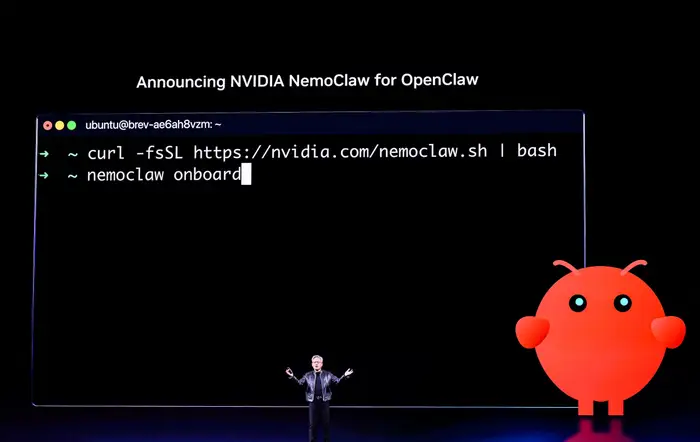
NVIDIA announced two specific components at GTC 2026 on March 16 in San Jose:
OpenShell is a YAML-based secure runtime with deny-by-default network and filesystem policies. It uses Linux network namespaces to isolate agent operations from the host system. The agent can only access what the policy file explicitly permits, and the policy file cannot be modified by the agent itself. NVIDIA ships a set of ready-made policy presets for common enterprise integrations including Slack, Jira, GitHub, npm, and PyPI, giving teams a verified starting point rather than writing policy from scratch.
Nemotron is the recommended local model family for privacy-sensitive tasks within NemoClaw. The model handles inference that should never leave your infrastructure. Cloud frontier models like Claude or GPT handle the rest, but only when your policy explicitly permits it. Exact benchmark figures for the NemoClaw-specific Nemotron build have not been published in official documentation at the time of writing.
The Honest Limitations
NemoClaw is early alpha software. NVIDIA's own documentation warns to expect rough edges.
Linux is the primary platform, specifically Ubuntu 22.04 and above with Docker installed. macOS works with Docker Desktop and Apple Silicon is supported, but local Nemotron inference is currently broken on macOS. Windows via WSL2 is experimental with unreliable GPU detection. For enterprise teams running Windows Server or macOS-heavy environments, this is the most important constraint to factor into your evaluation timeline.
The out-of-process policy engine is a strong architectural choice, but the YAML-based configuration requires backend infrastructure knowledge to use correctly. Misconfigured policies are a real risk during rollout. Teams expecting a consumer-grade setup experience will need to adjust expectations.
NemoClaw also does not solve every security problem OpenClaw has. It addresses infrastructure-level security and prevents agents from exceeding their defined permissions. It does not eliminate prompt injection, reasoning manipulation, or supply chain attacks that operate at the application layer. It is one layer of defense, not the complete picture.
Our Advice
For personal use: OpenClaw with strict manual oversight is the right setup today. Vet every ClawHub skill before installing it, do not run OpenClaw on a machine with access to shared company credentials, and keep it off any network that touches sensitive infrastructure.
For enterprise: Do not deploy OpenClaw agents to employee machines without the NemoClaw and OpenShell wrapper. The risk of token exfiltration via malicious skills is too high without OS-level enforcement in place. The right move now is to track the NemoClaw GitHub repo, test it in an isolated environment, and build it into your Q3 2026 evaluation cycle.
The question Jensen Huang put to enterprise leaders at GTC is the right one: what is your OpenClaw strategy? NemoClaw is the most credible infrastructure answer available today. It is not ready to deploy. It is ready to evaluate.
Key Facts at a Glance
- NemoClaw announcement: March 16, 2026, NVIDIA GTC, San Jose
- Built by: NVIDIA
- Built on: OpenClaw (open-source agent by Peter Steinberger, now at OpenAI)
- OS support: Linux primary (Ubuntu 22.04+); macOS works with Docker Desktop but local inference broken; Windows WSL2 experimental
- GA target: Q3 2026
- Core components: OpenShell runtime, out-of-process policy engine, privacy router, enterprise policy presets
- Local model: Nemotron (exact benchmark figures not yet published in official docs)
- Enterprise partners: Salesforce, Adobe, SAP, Cisco, CrowdStrike, Google, Microsoft Security, LangChain, Oracle, ServiceNow, Red Hat, Atlassian, Box
- CVE that triggered this: CVE-2026-25253, affecting 17,500+ OpenClaw instances
Sources & References
- NVIDIA NemoClaw at GTC 2026 (official announcement)
- Particula Tech: NVIDIA NemoClaw Explained
- DeepLearning.AI The Batch: NemoClaw overview
- Digitalways: NemoClaw Enterprise Security
- Medium: Does NemoClaw Replace OpenClaw?
Published: March 21, 2026. NemoClaw is in early alpha; this article will be updated as the platform approaches general availability.
Frequently Asked Questions
What is NemoClaw?
NemoClaw is NVIDIA governance and security layer for OpenClaw, announced at GTC 2026. It is not a competitor to OpenClaw: it is the armour that wraps around it with policy controls, security checks, and audit capabilities.
How is NemoClaw different from OpenClaw?
OpenClaw is the autonomous agent runtime, while NemoClaw is the governance layer on top of it. They are complementary: NemoClaw enforces what agents are allowed to do, while OpenClaw does the doing.
Should my organization adopt NemoClaw?
The post gives a clear verdict with honest limitations. NemoClaw is worth evaluating if you already run OpenClaw at scale and need policy enforcement, audit trails, and security guardrails. The limitations section covers what it does not solve yet, which matters before you commit.
Renovate QR Newsletter
Stay sharp on AI & tech
Our best reviews, comparisons, and guides — delivered weekly. No noise, no spam.